A short history of the Briens of Parramatta
Our Brien ancestry
can be traced back to the Celtic Dalcassian (Dál gCais) clan of west Ireland.
According to Annals of the Four Masters our ancestor was Cormac Cas, son of
Oilioll Olum who was King of Munster in the 3rd century. Ancestors of Cormac
Cas are said to include the royal lines of Spain, Scotland and Denmark.
In the 5th
century Óengus mac Nad Froich King of Munster was baptised a Christian in the
royal seat of Cashel county Tipperary, by Saint Patrick. In the 10th century
our clan, led by Brian Boru, rose to the High Kingship of Ireland. From that
time on our family have always been prominent in Irish history.

DNA evidence
DNA evidence suggests that the Dalcassian
(Dál gCais) originated outside of Ireland. There are strong indications of a
“bottle-neck” event sometime prior to 500AD which led to only a small number of
males responsible for the various Dalcassian family lines which exist today.
One of these male lines made the journey from mainland Europe (possibly from
France or Spain) and jumped first to the British Isles then to Ireland,
arriving around 500AD. Once in Ireland the Dalcassian settled along the Shannon
river valley and their numbers grew prolifically.
Brian Boru
With the
rise of Brian Boru our family took on the surname of O’Brien. Brian Boru was an
outstanding figure whose remarkable career as High King of Ireland ended on
Good Friday 1014AD with his death on the field of battle at Clontarf near
Dublin. This battle marks the point the Vikings in Ireland were finally subdued
and was celebrated as an Irish national holiday in 2014 to mark 1000 years
since the event.
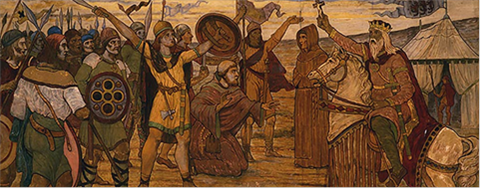
Fresco at the Dublin
City Hall titled “Before the Battle of Clontarf”
Brian
Boru’s legacy was not just his political and military leadership. There are
reliable accounts of Brian building fortresses, roads and bridges throughout
Ireland, and endowing the Church with lands and gifts, and it is likely that he
was responsible for major initiatives in the area of taxation and military
organisation. Perhaps Brian’s greatest achievement was the continuation of his
line as Kings of Munster and sometimes High-Kings, and his position as ancestor
and name-giver of the great O’Brien surname. In a reference he wrote in the
Book of Armagh in 1004 Brian Boru describes himself as ‘Imperator Scottorum’
i.e. Emperor of the Irish.
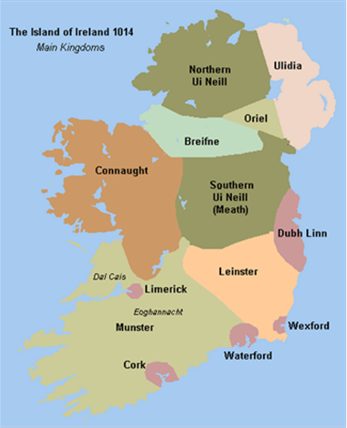
Major Kingdoms in
Ireland, circa 1014 AD
We are
descendants of Brian Boru’s son Teige (aka Tadc). Teige’s mother was Echrad nic Cearbhall,
daughter of Carlus mac Ailella of Uí Áeda Odba. Following the death of Brian
Boru our family continued to control vast areas of Western Ireland. Initially
this territory was called Munster, but in 1118 a family dispute saw Munster
divided into three Kingdoms. Our ancestors managed to hold the area in the
north known as Thomond (pronounced Toe-Man), the area to the south became known
as Desmond and a small area in the east known as Ormond.
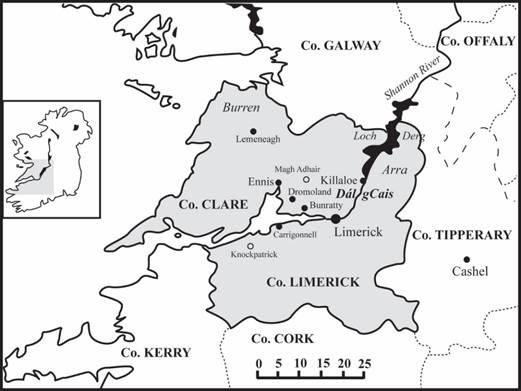
Map
of Thomond after the breakup of Munster in 1118.
Norman
Invasion
In 1169
people who originated in Scandinavia and France (known as Normans) invaded
Ireland and for the next 400 years much of Gaelic Ireland fell or was greatly
reduced. The O’Brien Kingdom of Thomond however resisted the Norman invasion of
Ireland, defeating them and their English (Anglo) allies in several notable
battles.
In 1174 the
O’Briens defeated a Norman army at the ‘battle of Thurles’ where over 1,700
were killed. Between 1200 and 1210 King John of England built a castle on the
site of an earlier fortification at Limerick known as King John’s Castle. Its
purpose was to defend the bridge crossing the River Shannon and protect the
Norman Kingdoms on the southern side of the river from the Gaelic tribes on the
northern side, in particular the O’Briens.
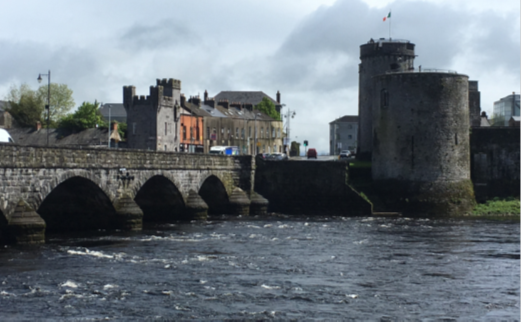
King John’s castle
with Thomond bridge crossing the Shannon river at Limerick
After
several decades Norman families from outside Thomond started to advance and in
1257 another major battle took place in which Conor O’Brien and his son Tadhg
defeated these Normans resulting in great loss of life.
Continuing
conflict between the Irish clans over who should be King of all Ireland
resulted in disunity and the O’Briens refused to support the O’Neill clan at
the ‘battle of Druim Dearg’ in 1260. The O’Neills were defeated by the Normans
and their leader Brian O’Neill, King of Cenel Eogain was killed. This led to
weakening of the O’Neill influence within Ireland which in turn benefited the O’Briens
politically.
In 1268 our
ancestor King Conor O’Brien was ambushed and killed whilst travelling through
the Woods of Siudáine in northern County Clare. He was henceforth known as King
Conor Na Siudáine O’Brien and was solemnly interred in nearby Corcomroe Abbey
by the monastic community. In recognition of the support they had received from
the O’Briens they raised a stone monument and an effigy of him wearing a crown in
his honor. Today Corcomroe Abbey is an Irish National Heritage site.
|
|
|
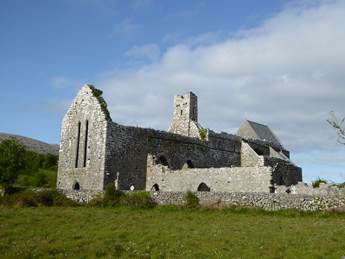
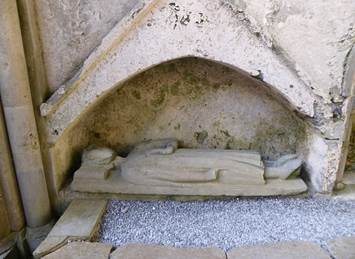
Corcomroe Abbey near
Ballyvaughan County Clare (L) and effigy of King Conor Na Siudáine O’Brien (R)
English
King Edward I saw the disunity between the Irish clans, in particular between
the O’Briens and O’Neills, as an opportunity to advance English influence
within Ireland. Edward I funded and encouraged his
close friend Thomas de Clare to occupy and settle in Thomond. Thomas de Clare
enlisted the support of Brian Roe O’Brien a deposed Thomond King and together
in 1276 they defeated our ancestor Turlogh Mor O’Brien, who escaped to Galway.
Turlogh Mor elicited the help of his cousin William de Burgh, and in 1277 their
combined force defeated de Clare and Brian Roe’s army at the ‘battle of
Moygreasan’. This left Turlogh Mor O’Brien the undisputed King of Thomond.
While both
Thomas de Clare and Brian Roe survived the Battle of Moygreasan one of the casualties
was de Clare’s brother-in-law Patrick FitzGerald. De Clare’s wife Juliana
FitzGerald blamed Brian Roe for the defeat and was intent upon avenging the
death of her brother. In responding to Juliana’s wishes, de Clare led Brian Roe
O’Brien into a trap which resulted in his murder. This set off tit for tat
reprisals known as the ‘Thomond civil war’ which wasn’t resolved until the
defining ‘Battle of Lough Rask’ in 1317.
Scottish
Invasion
Following
his victory over the English at the ‘battle of Bannockburn’ in June 1314 Scottish
King Robert the Bruce (Robert de Brus) envisaged a Celtic alliance between
Scotland, Wales and Ireland. In 1315 he sent an invasion force to Ireland led
by his brother Edward Bruce to depose the English and Norman aristocracy and subjugate
the Irish people under Scottish control. After winning a series of battles
Edward Bruce was proclaimed High King of Ireland on the 2nd May 1316. In September
1316 Robert Bruce joined his brother Edward in Ireland and the reinforced Scots
launched a massive campaign. The Scottish invasion created a complex political
situation that sparked a series of confrontations within Ireland known as the ‘Bruce
Wars’.
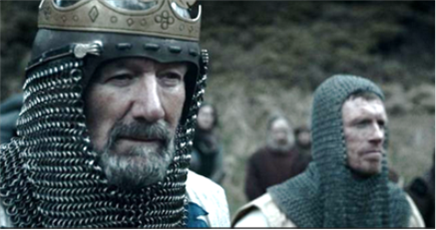
Portrayal of the
brothers Robert and Edward Bruce.
In March
1317 Robert and Edward Bruce led the 20,000 strong Scottish army towards
Thomond and met a much smaller O’Brien army led by our ancestor King
Muirchertach (pronounced Mur-Ca-Toc) O’Brien at Castleconnel. The two armies
stood across the Shannon River from each other, the O’Briens urging the Scots
to attack. In what could be argued as the turning point of the Bruce campaign
in Ireland, the Bruce brothers decided not to cross the Shannon and engage
Muirchertach O’Brien, instead they retreated and from that time on the Scottish
invasion was ineffective. In May 1317 Robert Bruce returned to Scotland leaving
his brother Edward in Ireland but after several years of mobile warfare, Edward
Bruce and his allies failed to hold the areas they had previously conquered.
Following
the Scottish retreat at Castleconnel, the Norman Lord Richard de Clare saw an
opportunity to attack Thomond. In May 1318 de Clare’s army began marching north
through Thomond raiding villages before a coalition of O’Brien, O’Dea and other
clans engaged them on the 10th May near Dysert O’Dea castle. In a military
display more akin to Norman tactics, in what is known as the ‘battle of Dysert
O'Dea’, the Irish coalition forces comprehensively defeated de Clare. Richard
de Clare was killed by the O’Deas during the action and the surviving Normans
were pursued and driven out of Thomond. This battle was one of the few
resounding Irish victories gained during the ‘Bruce Wars’ and Muirchertach O’Brien
was hailed as following in the footsteps of Brian Boru and “is regarded by many
today as an early Irish national visionary”.
Gaelic
Resurgence
Edward
Bruce was killed in Oct 1318 at the battle of Faughart, thus ending Scottish
rule in Ireland. The next 200 years saw stability in Thomond and the O’Briens
flourished. Under their stewardship Thomond experienced a Gaelic Resurgence and
developed into a prosperous sovereign state that was a bastion of Catholic,
Gaelic and Celtic culture. Evidence of this still exists with towns, castles,
churches, abbeys, houses and other areas of cultural significance built by, or
named after, our O’Brien family scattered across western Ireland.
Various
branches of the O’Briens spread out across territory previously held in Norman
hands. During the Gaelic Resurgence period The O’Briens reclaimed much of what
had been lost after the 1169 Norman invasion.
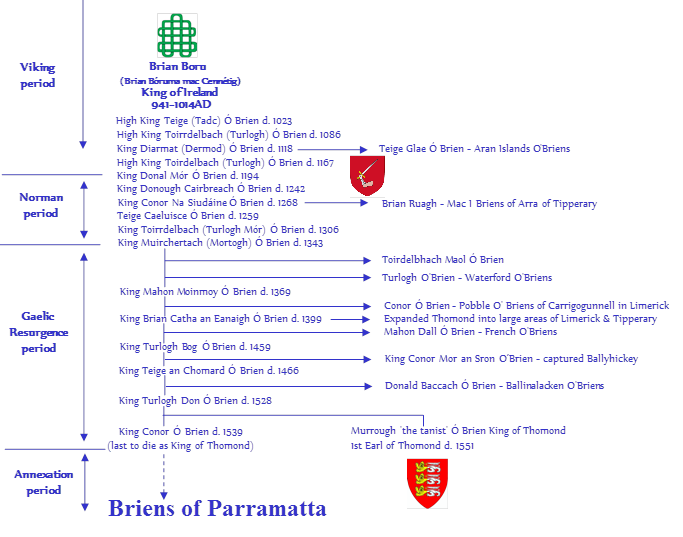
Chart showing some
the various periods of Thomond history and some of the family branches that
expanded the territory of Thomond
Teige an Chomhaid O’Brien
Teige an Chomhaid O’Brien became King of Thomond in 1461 after the death of his cousin King Donough O’Brien. Teige took advantage of England being distracted by the ‘Wars of the Roses’ and in 1464 led the Thomond army south through Desmond to enforce his rule over the Anglo-Norman settlers.
Teige’s military prowess was such that the Earl of Desmond was forced to give back to Thomond the entire territory of County Limerick. Teige was active in trying to drive the English out of Ireland and he formed an alliance with the Ó Néill clan which had significant success.
Whilst the alliance failed to drive the English completely out of Ireland, they did manage to restrict them to just a small area surrounding Dublin known as ‘the Pale’. The Mac-Firbis annals record that the people of Lenister wanted “Teige an Chomhaid O’Brien as King of Ireland” and claims he was the “greatest Ó Briain since Brian Bóruma himself”.
Teige an Chomhaid O’Brien married Anabella Burke of the de Burgh dynasty and they had at least three sons. The elder son was our ancestor Turlogh Don O’Brien who was born about 1455. Their second son was Donough O'Brien of Drumfinglas the progenitor of the O’Briens of Cahircorkran Rath parish and their youngest son was Donald Baccach O’Brien of Carrowduff who was the progenitor of the O’Briens of Ballynalacken.
Inchiquin Castle
Construction of Inchiquin Castle was probably started by King Turlogh Bog O’Brien about 1445 and was completed by his son Teige an Chomhaid O’Brien about 1461. Inchiquin Castle was used as the family home and seat of power. Teige’s nick name “an Chomhaid” is derived from the local name of the area where Inchiquin Castle is located.
This castle is situated at the northern side of Lough Inchiquin near Corofin County Clare. Though greatly dilapidated, is still a picturesque and interesting ruin, consisting of the remains of a barbican tower, keep, and old mansion-house attached to it. One description of it said “it sits on a rocky peninsula standing out in the water, with its grey walls relieved by the dark masses of the wooded hills behind, is eminently striking and imposing”.
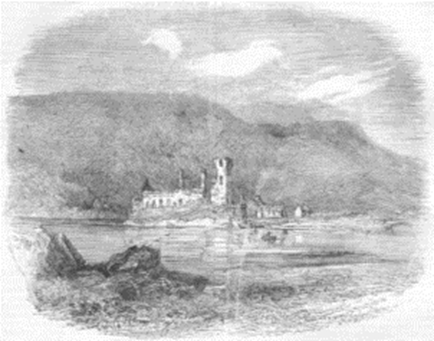
Drawing of Inchiquin Castle (Library Ireland)
The de
Burgh alliance
Teige an Chomhaid O’Brien died in 1466 and was succeeded as King of Thomond by his brother Conor Mor an Sron O’Brien. King Conor immediately took steps to sure up his alliances with the de Burghs of Galway. Ever since the Thomond civil war 1277-1317, the O’Briens and de Burghs had been allies, and this alliance was particularly evident during the defeat of the Normans in the battle of Dysert O’Dea in 1318 to which the de Burghs had contributed.
Conor
renewed the treaty with the de Burghs which committed Thomond to provide
“offensive and defensive” support of the de Burgh land of Clanricarde and visa
versa. Soon after the treaty was ratified the forces of Thomond were drawn into
a dispute between the de Burghs and the O’Kellys and Thomond troops were on the
march north to Galway. In 1467 the combined forces of Thomond and Clanricarde
defeated the O’Kellys at the battle of ‘The cross of Moighecroin’ in Galway.
In 1469
Clanricarde once again came under attack, this time from forces loyal to the
O’Donnells some of which were bent on extracting revenge for their defeat at
Moighecroin two years earlier. The O’Donnell force known as “the northern army”
were attacking settlements on the Clare / Galway border, in response King Conor
Mor an Sron O’Brien dispatched a force who joined with MacWilliam of
Clanricarde and they confronted the northerners at Glanog, a small river near
Cargin Castle in County Galway.
During
this skirmish “Donall the son of O'Conor of Corcomroe and many others not
enumerated were slain. Mac William and
the O'Briens however rallied their forces and placing themselves in battle
array pursued with one accord the army of O'Donnell. But this was of no
advantage to them for O'Donnell's army wheeled round on Mac William's and the
O'Brien's cavalry at the river called Glanog and there defeated them again;
they left many men, horses and valuable things behind and disgracefully fled.
This battle was called the defeat of Glanog”.
After the
defeat at Glanog, Conor Mor an Sron O’Brien undertook a programme of castle
building which included Mountcashel castle built around 1470.
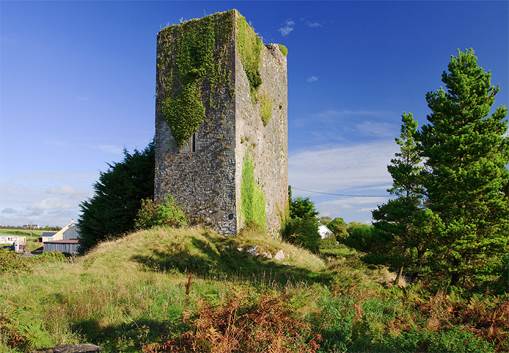
Mountcashel castle
built by Conor Mor an Sron O’Brien around 1470 (Geograph)
Turlogh Don
O’Brien
Turlogh Don O’Brien (our
ancestor) was the eldest son of Teige an Chomhaid O’Brien King of Thomond and Anabella
Burke. Turlogh Don was born around 1455 and when his uncle Turlogh Oge O’Brien
died in 1499, the Kingship of Thomond came to him.
In 1504
Turlogh Don O’Brien marched the army of Thomond into Galway in support of his
ally Ulick Burke of Clanricarde. Burke was preparing to defend against an
attack from Gerald FitzGerald, 8th Earl of Kildare who led an army 6000 strong.
The opposing forces met on the 19th of August 1504 at Knockdoe Hill near
Lackagh, County Galway. Known as the ‘battle of Knockdoe’ it was probably the
largest and bloodiest battle fought in Ireland for hundreds of years. Kildare’s
forces were victorious although his army suffered many casualties.
Irish
historian Gerard Anthony Hayes-McCoy said the Battle of Knockdoe “led to the
death of Gaelic Ireland”. Turlogh Don O’Brien survived unscathed but there is a
mention of two graves on the hillside described as; “the resting place of two
sons of O’Brien of Thomond”.
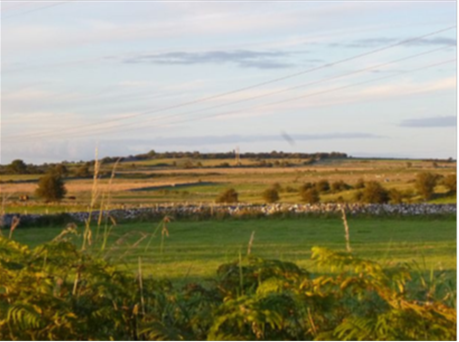
Knockdoe Hill near
Lackagh, County Galway, site of the great battle in 1504
In 1510
Turlogh Don O’Brien turned the tables on Kildare. In a bold move, a combined
O’Brien and MacNamara force surround Kildare’s encampment during the night and
at dawn surprised Kildare in what became known as the ‘Battle of of Móin na
mBrathar’ (a.k.a battle of the Shannon river).
Kildare’s
forces were routed and Turlogh Don O’Brien, in what could be seen as revenging
the defeat at Knockdoe, returned to Limerick city in triumph. The New Gill
History of Ireland describes the defeat of Kildare at ‘Móin na mBrathar’ as initiating
the decline of the The Lord Deputy’s powers in Ireland, which “ultimately led
to wholesale changes in Irish government”.
Kildare
described Turlogh Don O’Brien as “a mortal enemy to all Englishmen and the most
maliciously disposed of any that I have heard of”.
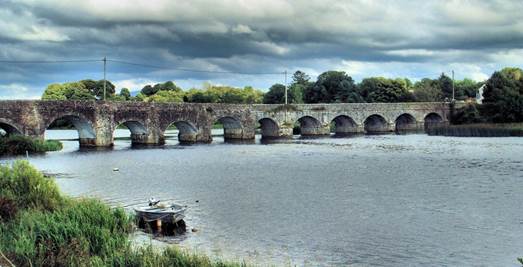
O’Briens bridge,
near the site of the battle of Móin na mBrathar in 1510
Bunratty
Castle
Around 1475
Turlogh Don O’Brien married Raghnailt MacNamara, daughter of clan chief John
(Rory) MacNamara. The MacNamaras were renown castle builders and Bunratty
Castle in southern County Clare is quite likely the best example of their
skill.
Bunratty dates
from about 1425 and passed into the possession of the O’Briens around the time
of Turlogh Don and Raghnailt MacNamara’s marriage. The structure that stands
today was restored in the 1960s and is now a major tourist attraction. Turlogh Don O’Brien was inaugurated
King of Thomond in 1499 and this most likely dates when the Thomond seat of
power moved from Inchiquin Castle to Bunratty.
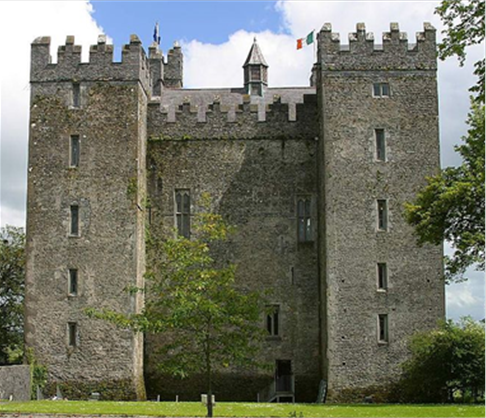
Bunratty Castle
FitzGerald alliance
and Treaty with France
Raghnailt
MacNamara died around 1489 and in 1495 King Turlogh Don O’Brien married Ellen
Fitzgerald, daughter of Thomas FitzJames FitzGerald 7th Earl of Desmond and his
wife Ellice de Barry. It was notable as this was the first union between our
O’Brien line and the FitzGerald family since the 13th century, and was a clear
demonstration that Turlogh Don saw that an alliance with the powerful FitzGerald
family would be in the best interests of Thomond.
The FitzGeralds
were a Norman line who continued to harbor resentment against King Henry II’s
claim of 1171 over their territory. They also supported the House of York
during ‘The Wars of the Roses’ therefore putting them at odds with King Henry
VIII who descended from the opposing House of Lancaster.
The alliance
between the O’Briens and FitzGeralds would come to dominate Thomond politics
for the next fifty years.
This
alliance was further cemented in 1523 when Turlogh Don O’Brien signed an accord
with James FitzGerald 10th Earl of Desmond committing Thomond to be party to a
treaty with France. As France at this time was an adversary of England, by
consequence Thomond was as well.
At around
the same time King of England Henry VIII and Charles V of Spain were signing a
treaty of their own to form an alliance against France. These treaties probably
appeared benign to the O’Briens at the time as neither England or Spain were at
war with France and France was occupied with defending its interests in Italy.
But the
situation changed in February 1525 when Spanish troops attacked the French in
what is known as the ‘Battle of Pavia’. In the action French King Francis I was captured by the Spanish and like a game of
chess; the game was over. Spain had
defeated France and in turn England, as Spain’s ally, also had a victory. The
Irish parties had not been called upon in this war but having sided with France
against England, the situation between England and Thomond in the aftermath of
Pavia was decidedly tense.
Turlogh Don
O’Brien died in 1528 and he and Raghnailt MacNamara’s eldest son Conor O’Brien (our
ancestor) succeeded him as King of Thomond.
Silken
Thomas Affair
In July
1534 Thomas FitzGerald, the son of Gerald FitzGerald, 9th Earl of Kildare
attacked Dublin Castle in an act of defiance towards English King Henry VIII.
Thomas FitzGerald and his followers wore silk fringes on their helmets thus
giving this event the name ‘the Silken Thomas Affair’. While the attack on
Dublin Castle failed, it had directly threatened English rule in Ireland. King
Henry decided action was required to place his Irish realm on a more secure
footing and made the arrest of Silken Thomas FitzGerald a priority.
Thomas now
realising his life was in danger sought refuge with the O’Briens and our
ancestor King Conor O’Brien granted him sanctuary in Thomond. FitzGerald who
had been acting Lord Deputy of Ireland brought with him the treasures of his
office including silver plates and other goods with the intention of using
these as payment for his escape. For nearly a year Thomas FitzGerald remained
out of King Henry’s reach in Thomond. If Henry VIII had not realised it before,
he was certainly aware now just how little influence he had west of the Shannon
river. Henry later said that “of all the clans in Ireland, the O’Briens are the
ones who worry me the most.”
Thomas
FitzGerald had initially planned to escape to Spain, but this fell through and
in October 1535 he was assured by the new Irish Lord Deputy Leonard Grey, that
Henry VIII would be merciful, so he gave himself up. This turned out to be a
mistake as despite Grey’s assurances that FitzGerald would be treated fairly,
King Henry was not in a forgiving mood and Silken Thomas FitzGerald along with
five of his uncles, some of which were completely innocent, were executed at
the tower of London on the 3rd February 1537.
In
retribution for our part in the ‘Silken Thomas Affair’, King Henry VIII ordered
Leonard Grey to attack Thomond. Grey marched his army to Carrigogunnell Castle
located within the territory of ‘Pobble O’Briens’ in County Limerick. The 1536
attack at Carrigogunnell was particularly ferocious and resulted in a massacre
of men women and children.
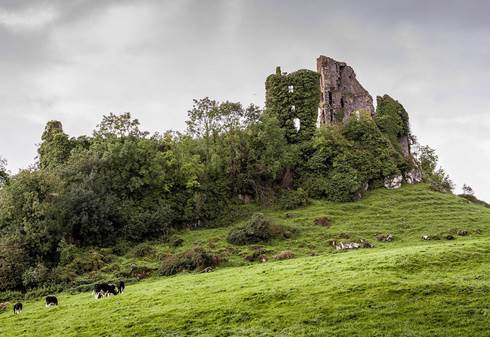
Ruins of Carrigogunnell
Castle, County Limerick. Site of the massacre of 1536.
King Conor O’Brien
was appalled and obviously deeply affected by the carnage Grey’s army had
inflicted on the people at Carrigogunnell. Conor realised that if Grey’s army
were to cross the Shannon and continue their violent behavior in greater
Thomond, then all men, women and children in his realm would be placed at risk.
Seeing no other option King Conor met Grey at Limerick in July 1537 to forge a
peace deal.
King Conor
negotiated “peace with your majesty for a yere” by agreeing to remove a bridge that
crossed the Shannon river at Montpelier. This arrangement led to an argument
between Conor and his younger brother Murrough O’Brien who opposed the deal.
But Conor held the upper hand, as Grey also wanted to take Conor’s son Turlogh O’Brien
as a hostage, but instead Conor managed to persuade Grey to agree with an
alternative option whereby Turlogh would be sent to live with James FitzGerald
the Earl of Desmond. It seems Grey was unaware that James FitzGerald was in
fact Conor’s brother-in-law, but when King Henry VIII heard of this
arrangement, he was “ill pleased” as he recognised the relationship between the
parties and loudly declared that “the oaths and indentures of the Irish
chieftains were not worth a farthing, as the Lord Deputy (Leonard Grey) had not
taken their hostages”.
King Conor
O’Brien was the progenitor of the Earls of Thomond and Viscounts Clare. The
Earls of Thomond lived at Bunratty Castle as well as at Billing Northampton
shire England. They eventually became extinct in 1741 when Henry O’Brien the
8th Earl of Thomond died leaving no male heir. The Viscounts Clare were
attainted in 1691 for their role in opposing the English in the Williamite war following
which their title was no longer recognised in England, but continued to be
recognised in France where they lived until 1774 when Charles O’Brien the 7th
Viscount Clare died unmarried at age 17. The ‘Briens of Parramatta’ are an
extension of this Viscount Clare line that became separated from our French
relatives in the wake of the Williamite war (1689-1691).
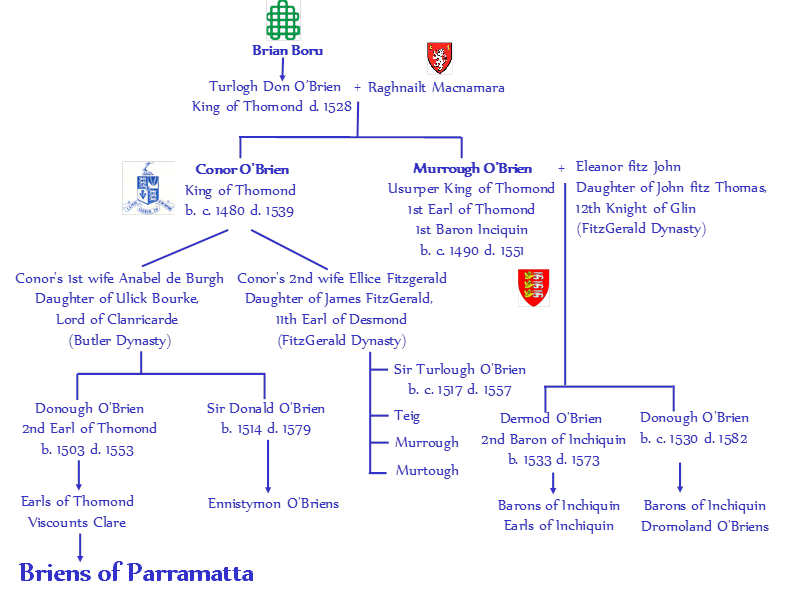
Chart showing the
descendant lines of the brothers Conor and Murrough O’Brien
Surrender
and Regrant
King Conor O’Brien
died in 1539 after being King of Thomond for eleven years and was “interred in
the O’Brien Chapel at Kilfenora Cathedral with great magnificence.” His eldest
son Donough O’Brien (our ancestor) did not succeed him as King however Donough
later became the 2nd Earl of Thomond.
The throne
of Thomond next went to Conor’s younger brother Murrough in controversial
circumstances. By the early 1540s the situation had reached a stalemate with
Murrough O’Brien defiantly holding out the English forces and King Henry VIII looking
for a way to remove Murrough. By 1543 Henry had concluded that it would be
easier to annex Thomond rather than conquer it through direct confrontation. Henry,
along with his Lord Deputy of Ireland Sir Anthony St Leger, developed a policy
known as ‘surrender and regrant’ that involved the Irish Monarchs surrendering
their title of ‘King’ and in return be granted English titles of Earls and
Barons. In addition, the Catholic Irish Monarchs were required to convert to
the Anglican Protestant church in a process known as “taking the King’s
shilling.”
Murrough
probably thinking he would never get a better offer agreed. So, it came to pass
that on the 1st July 1543 the then King of Thomond, Murrough O’Brien,
surrendered the crown of Thomond in a ceremony at Greenwich England to Henry
VIII. In return Murrough O’Brien ‘the tanist’ was granted the titles of 1st
Earl of Thomond and 1st Baron of Inchiquin.
From that
day on the main O’Brien lines were titled Earls of Thomond, Marquis of Thomond and
Barons of Inchiquin and these became Protestant lines of our family.
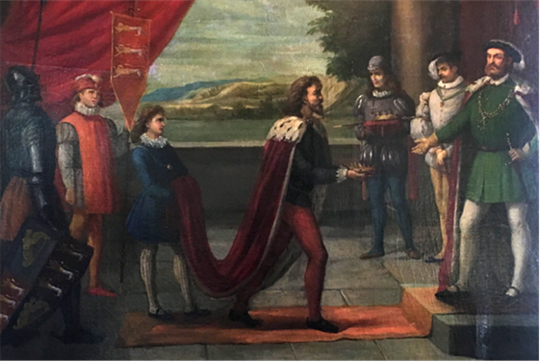
O’Brien surrender and regrant to King Henry VIII 1st
July 1543 at Greenwich Castle, London
Murrough
O’Brien was the progenitor of several titled lines i.e. Barons of Inchiquin,
Earls of Inchiquin and the Marquis of Thomond. Of these the only one which
continues today is the Baron of Inchiquin line; still living close to their
traditional home of Dromoland in County Clare represented by the head of the O’Brien
clan Sir Conor Myles O’Brien 18th Baron of Inchiquin.
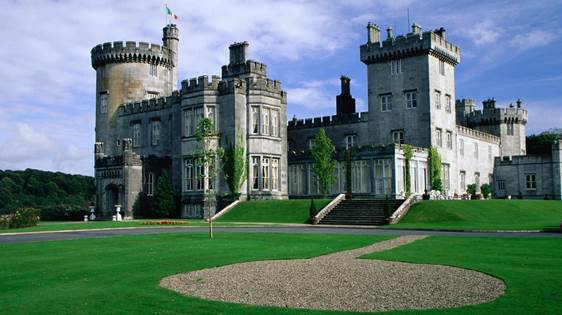
Dromoland Castle,
County Clare, Ireland
Battle of
Spancill Hill
Murrough
O’Brien’s actions in accepting the English titles had a sting in the tail that
would only be noticed after Murrough’s death in 1551. What was not fully
appreciated by the O’Briens at the time was that the English titles went hand
in hand with the English land and asset hereditary system known as
Primogeniture. This had ramifications not only for the O’Briens, but also for
all of the Gaelic clans, as the English system is completely different to the
Irish Gaelic system of distributing assets to the next generation.
In
Primogeniture, the firstborn legitimate child inherits the parent's entire or
main estate; whilst in the traditional Irish Gavelkind system each of the sons
has a chance of being clan leader and a share of their father’s estate.
The
original deal agreed to between the O’Briens and King Henry VIII was that
following Murrough O’Brien’s death, King Conor O’Brien’s eldest son Donough
O’Brien (our ancestor) would assume the title of 2nd Earl of Thomond, but only
for his life time.
In 1552,
Donough O’Brien wrote to King Henry’s successor Edward VI requesting the title
of Earl be extended to include following generations. Edward did this and more,
he extended the title to include all following generations plus threw in all of
the lands that Murrough O’Brien had owned as well.
The big
losers out of this deal were Teige and Donough the sons of Murrough O’Brien,
1st Earl of Thomond. Donough’s brother Donald O’Brien of Dough was also less
than happy and so in April 1553 Donald and his half-brother Turlogh O’Brien attacked
Donough the 2nd Earl at his home at Clonroad Castle. While there is no proof
that this attack contributed; Donough O’Brien was found dead about a week
later.

Those inside the red
line were aligned against Conor O’Brien 3rd Earl of Thomond following the
‘surrender and regrant’ of 1543
Donough’s
son Conor O’Brien (our ancestor) aged 19 now inherited the title of 3rd Earl of
Thomond. Fearing for his life Conor fled Clonroad and Donald O’Brien of Dough took
up residence there and named himself ‘King of Thomond’.
In June
1558 the Irish Lord Deputy Thomas Radclyffe arrived in Limerick with a large
army and proclaimed Donald O’Brien of Dough, as well as his co-horts Teige and
Donough O’Brien (the sons of Murrough, 1st Earl of Thomond) to be traitors.
Radclyffe
reinstated Conor O’Brien the 3rd Earl as ruler of Thomond. Upon hearing this
news Donald O’Brien of Dough fled to Ulster, Teige O’Brien fled and sought the
help of Gerald FitzGerald, 14th Earl of Desmond and Donough O’Brien holed-up in
Inchiquin Castle.
Conor
O’Brien now sought the assistance of Richard Burke, 2nd Earl of Clanricarde and
their combined armies lay siege to Inchiquin Castle in an attempt to evict
Donough O’Brien. Donugh’s brother Teige along with Gerald FitzGerald at the
head of the Desmond army came to Donough’s rescue.
These two
great forces met in June 1559 at Spancill Hill about 5Km NE of Ennis. On one
side were the armies of Conor O’Brien, 3rd of Thomond and Richard Burke, 2nd
Earl of Clanricarde and on the other side the army of Gerald FitzGerald, 14th
Earl of Desmond.
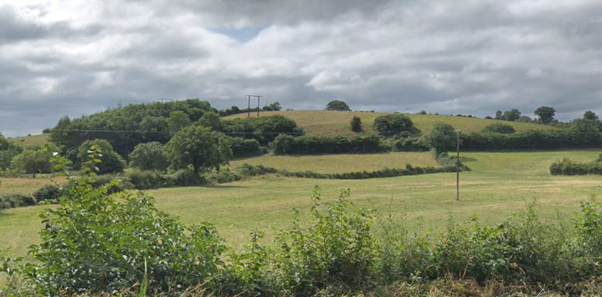
Spancill Hill, County Clare - site of the battle in June
1559
In what is
known as ‘the Battle of Spancill Hill’ the forces of Gerald FitzGerald, 14th
Earl of Desmond with the support of Teige O’Brien prevailed. Also known as the ‘Battle
of the three Earls’ the result was a major defeat for Conor O’Brien. It also
was a notional defeat for Lord Deputy Thomas Radclyffe as he had supported
Conor in 1558. Conor’s defeat at Spancill Hill forced Radclyffe to return to
Thomond in 1560 in a show of strength to again support Conor O’Brien in his
position as ruler of Thomond.
Ultimately
Conor O’Brien, the 3rd Earl found a solution to the continued uprising by
allowing Donough O’Brien to remain at Inchiquin Castle and offering Donald
O’Brien of Dough a large tract of Thomond known as Corcomroe.
Sir Daniel
O’Brien
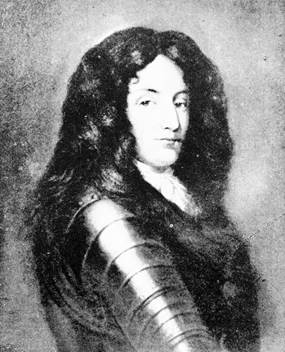
Sir Daniel O’Brien
Daniel
O’Brien was born about 1577 and was the youngest son of Conor O’Brien the 3rd
Earl of Thomond. Daniel was our ancestor and he first came to prominence during
a conflict known as the ‘Nine Years War’ which occurred between 1594 and 1603.
This was a period when an Irish revolt against Elizabeth I Queen of England took
place led by Hugh O'Neill the Earl of Tyrone. In 1598 O'Neill’s rebel army was victorious
over the English led by Henry Bagenal at the battle of Yellow Ford, after which
the revolt spread across most of Ireland including County Clare.
In February
1599 Daniel O’Brien, then aged in his early 20s, was in charge of defending
Tromora castle, one of Queen Elizabeth’s strongholds in western County Clare when
the rebel army attacked. Daniel was injured in the fight and the rebels
captured the castle. Daniel was later released and Tromora was re-captured.
When Queen Elizabeth I heard of Daniel’s heroics she summoned him to London
where he arrived in mid-1601.
In gratitude
Queen Elizabeth I promoted Daniel O’Brien to Captain, granted him Carrigaholt Castle
(which had been recently confiscated from the McMahons) along with the
extensive estates of Ibrickan and Moyata (in south western County Clare).
Situated
over-looking the Shannon River estuary Carrigaholt Castle is a short distance
from the fishing village of the same name. Today Carrigaholt Castle consists of
a well-preserved tower house, but the surrounding buildings have not survived.
The property has been un-occupied since 1906 and is listed as an Irish National
Monument. Some of the improvements Daniel O’Brien made to the building can
still be seen, like the fire place and chimney installed on the 5th floor and
many of the windows were Daniel’s additions.
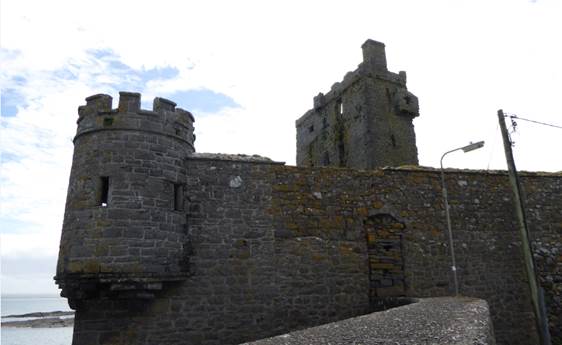
Carrigaholt Castle, County Clare, Ireland. Home of Sir
Daniel O’Brien, 1st Viscount Clare.
William Penn
(1621-1670) after whom Pennsylvania is named, stayed here on his way to America
in 1646.
Daniel
O’Brien arrived back in Ireland in November 1601 and proceeded to Kinsale in
County Cork where O’Neill’s Irish rebels had the English army hemmed in against
the coast. Even though the Irish rebels held the better field position, they
were ultimately defeated in what is known as the ‘battle of Kinsale’. This took
place on the 24th December 1601 and is seen as the ultimate battle in England's
conquest of Gaelic Ireland. The rebel
defeat at Kinsale resulted in O’Neill signing the Treaty of Mellifont in 1603. In
recognition of his actions at Kinsale and in other battles, Daniel O’Brien was
appointed Knight on the 1st July 1604 at Leixlip in County Kildare.
Daniel married
Catherine Fitzgerald from a prominent Catholic family linked to Glin Castle in County
Limerick. An inscription in Carrigaholt Castle which includes the date “1603”
probably marks this event. Daniel and Catherine had four sons; we descend from
the youngest Teige Roe O’Brien (the red headed one). They also had a daughter
named Mary O’Brien who married Torlach Rua MacMahon; they in turn had a
daughter famous in Irish folk law known as Máire Rúa O’Brien (Red Mary).
Around the
time of his marriage Daniel O’Brien converted to Catholicism and in 1642 became
a member of the Supreme Council of the Irish Catholic Confederates. Daniel (now
Sir Daniel O’Brien) fled Ireland in 1651 after surrendering to Cromwell’s army
and supported Charles II (the future King of England) whilst he was in exile in
Europe; after he had fled England following the be-heading of his father King Charles
I in 1649.
Sir Daniel O’Brien
returned to England with the restoration of King Charles II in 1660, and in
1662 Daniel had all of his estate forfeited in 1651 restored and also received
the title of 1st Viscount Clare from King Charles II. Sir Daniel O’Brien 1st
Viscount Clare died in 1664; his grave site remains unknown.
Eleven
Years War
The Eleven
Years War between 1641 and 1652 was the most destructive conflict in Irish
history with estimates of up to 600,000 deaths from fighting, as well as
war-related famine and disease. This war had its roots in the conquest and
colonisation of Ireland (known as the Plantation policy) implemented by Queen
Elizabeth I which created a general state of oppression in Ireland that
impacted most Anglo-Irish Catholics.
In
September 1639 the Lord Deputy of Ireland Thomas Wentworth was recalled to
England by King Charles I to be his key advisor. Charles was struggling to deal
with an incredibly complex and deteriorating political situation involving his
English parliament, who were supporting a group of Scottish Presbyterians known
as ‘Covenanters’ who in turn were waging a war against England. Wentworth’s
replacement in Ireland, Christopher Wandesford died soon after taking office
and this left Ireland leaderless as it moved into 1641.
In Ireland
alliances formed between the Old Norman English and the Gaelic Irish (who were
both Catholic and both supported King Charles I) these two groups were
collectively known as ‘Royalist’ and were opposed to the New English Protestant
settlers (who supported the English parliament against Charles I). This faction
were known as the ‘Parliamentarians’.
On the 23rd
of October 1641 a group of Royalist attacked Dublin Castle, the assault failed
but it set off an uprising that impacted all of Ireland. In County Clare news
of the Royalist uprising reached Barnabus O’Brien the 6th Earl of Thomond in
early November. Barnabus immediately called a meeting at Ennis to work out how
to keep the peace. At that meeting Barnabus nominated his first cousin Dermot
O’Brien as Captain of a new peace keeping force.
It wasn’t
long before the Catholics in County Clare started attacking the English and
Scottish Protestant settlers, and Barnabus O’Brien’s peace keepers swung into
action. But the scale of the attacks was beyond what Captain Dermot O’Brien
could cope with so more companies of peace keepers were formed. These were
garrisoned with the settlers and for a time this strategy worked and the
attacks subsided. Unfortunately for Barnabus there was no funding available for
this initiative so he had to foot the bill for the military expenses. To try
and recoup his losses, Barnabus O’Brien decided to impose a levy on those
townlands housing one of his peace-keeping garrisons.
Not
surprisingly the settlers came up with a plan to avoid this new tax, by simply
moving of their own accord to a nearby castle which did not require the protection
of a garrison. Barnabus O’Brien took Umbridge at the tax avoiders and ordered
Dermot O’Brien to seize the possessions of “any English that should offer to
forsake their dwellings.”
This had
the effect of turning Barnabus’s companies from peace keepers into Royalist
aggressors, and led to an escalation of violence against the English settlers.
A notable example was the siege at Ballyallia Castle near Ennis in February
1642. Based on intelligence that weapons of war were being concealed there, Dermot
O’Brien’s troops besieged the castle. A list of those involved in the siege includes
our ancestor Teige Roe O’Brien, the youngest son of Sir Daniel O’Brien. The
English occupants were finally forced out in mid-March 1642 when they ran out
of food & water; allowing Dermot O’Brien’s troops to take the castle.
Also in 1642 the Old Norman English and the
Gaelic Irish Catholics moved to fill the power vacuum left by the vacant Lord
Deputy position by establishing a “Supreme Council of Confederate Catholics.” Present
in their ranks from the start was our ancestor Sir Daniel O’Brien. These Confederate
Catholics operated as the national Irish government and established their own ‘Confederate
army’ who considered themselves ‘Royalist’ loyal to King Charles I, however King
Charles didn’t see them that way. In fact, Charles ordered his own ‘Royal’
army, led by a distant cousin of Sir Daniel O’Brien i.e. Murrough O’Brien 1st
Earl Inchiquin, to fight against the Confederates.
Murrough
O’Brien had studied military tactics in Spain and Italy and was a very capable
commander, winning a number of notable battles against the Confederate army, particularly
memorable was ‘the battle of Liscarrol Castle’ on the 3rd September 1642 where
the Confederates suffered great losses.
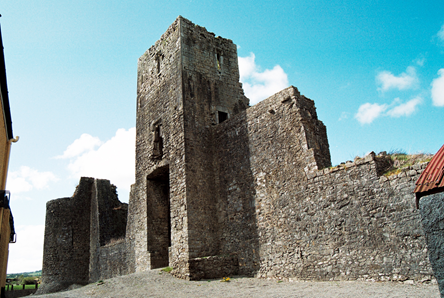
Liscarrol Castle in
County Cork, site of the battle in September 1642
In 1643 the
Parliamentarians took up arms in England against King Charles ‘Royal’ army initiating
a civil war. King Charles now struggling to fight wars in England as well as
Ireland, proposed a cease fire with the Irish Confederate Catholics and in
September 1643 a Cessation of Arms was initiated between Murrough O’Brien’s
Royalist forces and the Confederate army. King Charles also needed manpower in
England so negotiations began to bring the Confederates into the English
conflict on the Royalist side.
In late
1643 Murrough O’Brien travelled to England with his forces to support King
Charles army in the civil war. Expecting to be rewarded by King Charles,
Murrough was left disappointed when he was over-looked for the presidency of
Munster.
Murrough O’Brien
took this snub personally and after returning to Ireland in July 1644 decided
to switch sides for the ‘Parliamentarians’. As the Cessation of Arms of 1643
was only declared between the Royalist and the Irish Confederates (not the
Parliamentarians) Murrough O’Brien once again took up arms in Ireland on the
Parliamentarian side against the Confederates.
Murrough
O’Brien’s Parliamentarian army won a series of battles during 1645/46 expelling
the Confederates from Cork, Youghal and Kinsale. The Parliamentarians in
England took notice of Murrough’s achievements and in 1647 appointed him
president of Munster. This appointment gave Murrough new impetus and in the the
summer and autumn of 1647, he mounted a major military offensive against the
Confederates during which he stormed and captured Dungarvin, Cappoquin and
other garrisons.
But it was
the attack at the ‘Rock of Cashel’ in County Tipperary on the 15th of September
1647 that is the most memorable. Many people fled to the Cashel thinking it
would be a safe place to hide from Murrough O’Brien’s approaching Parliamentarian
army. This was a reasonable assumption as it had been a stronghold for
centuries. But when Murrough O’Brien arrived at the gates his army was ruthless,
they burned down the defenses, massacred soldiers, civilians and priests and
desecrated the Cathedral of St Patrick. The slaughter was followed by extensive
plunder. There was much of value inside, for apart from pictures, chalices and
vestments of the church, many of the slain civilians had also brought their
valuables with them. The sword and mace of the mayor of Cashel, as well as the
coach of the bishop were captured. The plunder was accompanied by acts of
iconoclasm, with statues smashed and pictures defaced. The deserted town of
Cashel was also torched.
The
atrocity at Cashel caused a deep impact in Ireland, as it was the worst single
atrocity committed in Ireland since the start of fighting in 1641 and took
place at one of the chief holy places of Ireland. The slaughter of the garrison
at Cashel and the subsequent devastation of Catholic held Munster earned Murrough
O’Brien the Irish nickname, Murchadh na Dóiteáin or “Murrough of the Burnings.”
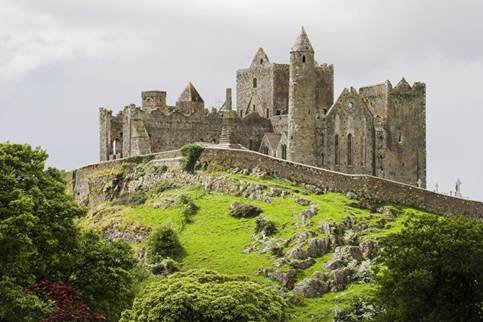
Rock of Cashel site
of the massacre on the 15th of September 1647
On the 3rd
of April 1648, Murrough O’Brien did another back flip and renounced his support
for Parliament and declared for King Charles I. He called for a truce with the
Confederates - which was readily accepted by Sir Daniel O’Brien and the
Anglo-Irish lords on the Supreme Confederate Council. By January 1649, after
several years of in-fighting and indecision, the initial intent of the
Cessation of Arms of September 1643 regarding an alliance between the Irish
Confederates and King Charles’ Royal Army could finally be ratified. Known as
“The Second Ormond Peace” it was signed on the 17th of January 1649.
Three days
after the Ormond Peace alliance was signed the situation was turned completely
upside-down when the English Parliament charged King Charles I with “high
treason against the people of England.” The King's trial opened with Charles
refusing to answer the charges, saying that he did not recognise the authority
of the High Court, but he was found guilty of the charges against him and
sentenced to death on the 27th January 1649; he was executed three days later.
With the
monarchy overthrown, England became a republic. The Scottish Parliament
declared Charles’s eldest son (also Charles) then aged 18, to be King of
Scotland, England and Ireland. This intrinsically made Charles II a threat to
the new Republic of England; young Charles eventually escaped England for
France (via Scotland) in 1651.
The new
English republic now turned its sights towards Ireland. One reason for this was
the Ormond Peace alliance, it was still in place and posed a threat to the Parliamentarians.
Oliver Cromwell was selected to take command of the English campaign in Ireland
and landed at Dublin on the 14th August 1649 with thirty-five ships filled with
troops and equipment. A further seventy-seven ships landed two days later.
Murrough
O’Brien was now on the side of the Royalist Irish forces and fought against Cromwell’s
‘New Model Army’. They met In December 1650 at Mallow in County Cork and
Murrough ‘of the Burnings’ was defeated. After the defeat Murrough left Ireland
for France and eventually joined King Charles II whilst in exile.
Cromwell’s
army captured Sir Daniel O’Brien’s home of Carrigaholt Castle in 1651 after
which Cromwell’s army sailed up the Shannon river estuary and lay siege to
Limerick city. By this time the ‘Supreme Council of Confederate Catholics’ had
been dissolved and Sir Daniel O’Brien, along with his son Teige Roe and
grandson Daniel left Ireland for France to join Charles II in exile.
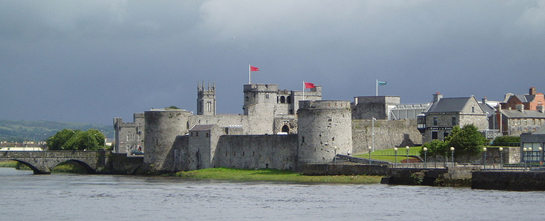
Limerick scene of
the siege of 1651
1651 marked
the end of Cromwell’s Irish campaign, and brought the Eleven Year war to a
close. Oliver Cromwell returned to England and in 1653 was sworn in as Lord
Protector. Oliver Cromwell died in 1658 and in 1660 the English Parliament
decided they wanted a monarch back on the throne and offered the crown to
Charles II.
Charles II was
still in exile when the message reached him at Breda in the Netherlands on the
8th May 1660. Sir Daniel O’Brien returned to England with King Charles II
arriving in Dover on the 25th of May 1660; reaching London four days later. Our
ancestor Sir Daniel O’Brien was mentioned in the King’s declaration as one of
the “objects of his especial favor.” In return for his services Sir Daniel
O’Brien had all of the lands and estates that had been forfeited in 1651
restored to him and in 1662 was granted the title of 1st Viscount Clare.
Máire Rúa
O’Brien
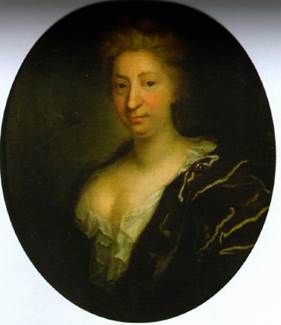
Máire Rúa O’Brien
(about 1645)
Máire Rúa
O’Brien (1615-1686) is a very colorful character in our family history. There
are many stories about her, most of them far fetched such as she had
twenty-five husbands and that she had been sealed into a hollow tree and left
to die. Some stories may be more truthful e.g. that she once threw a servant
girl out of a castle window and she landed on a pig. On account of her flaming
red hair she was commonly known as ‘Red Mary’.
Red Mary
was the daughter of Turlough MacMahon (a.k.a. Torlach Rua MacMahon) the Gaelic
Lord of East Corcabaskin (i.e. Clonderlaw). Her mother was Mary O’Brien, sister
of Sir Daniel O’Brien 1st Viscount Clare.

Diagram showing
relationship between the Earls of Thomond, Sir Daniel O’Brien 1st Viscount
Clare and Máire Rúa O’Brien
Mary’s 2nd
husband was Conor O’Brien of Leamaneh who was killed in a skirmish with
Cromwellian soldiers in July 1651, leaving his widow to marry a 3rd time.
Mary’s new husband was John Cooper, an officer of the parliamentary army whom
she supposedly picked at random. With her husband’s assistance Mary was able to
secure favour from the royalist Lord Deputy Ulick de Burgh, 1st marquis of
Clanricarde and preserve her estate intact for the benefit of her children,
most notably her eldest son by her 2nd marriage, Donough O’Brien (later 1st
Baronet) who would inherit a considerable portion of his father’s Leamaneh
lands.
Later,
Donough O’Brien moved the family seat from Leamaneh to Dromoland, where Mary
may have spent the final years of her life.
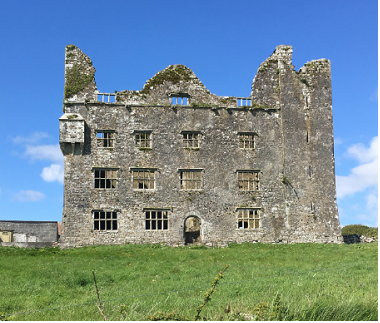
Leamaneh Castle,
near Corofin County Clare. The oldest section built around 1480 by our ancestor
Turlogh Don O’Brien
Williamite
War
When King Charles
II died in 1685, he was succeeded by his younger brother James who became King
James II. James was only King for a short time and in 1688 he was deposed in
the ‘Glorious Revolution’ and fled to France. James II wanted to re-gain his
throne and planned to do this by using Ireland as a base from which to launch
an attack upon England. This initiated the Williamite War between the English/Dutch
forces of King William of Orange (known as Williamites) and the Irish/French
forces led by James II (known as Jacobites).
In 1689
French troops landed in Ireland and the combined Irish/French force fought
several battles against the English/Dutch force; most notably at Boyne River
and Aughrim. The battle at Boyne River in 1690 saw the opposing armies led by
the Catholic King James II and, opposing him, his nephew
and son-in-law, the Protestant King William III (‘William of Orange’) who had
deposed James the previous year. Though the result at Boyne River was indecisive,
James lost his nerve and returned to exile in France.
The
Williamites eventually won the war with the Jacobites surrendering Limerick in
1691. A treaty of peace was signed on the 3rd October 1691. The stone on which
it was signed is still to be seen on a pedestal beside Thomond bridge at
Limerick.
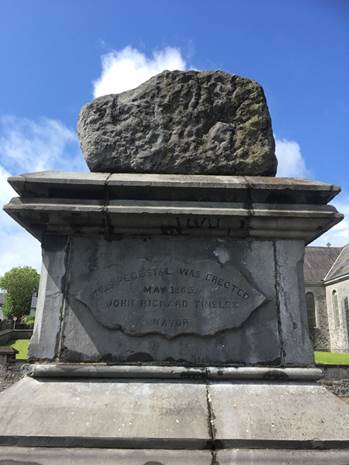
Treaty Stone located
next to Thomond bridge, Limerick (2018)
Our branch
of the O’Briens were Catholic Jacobites and established a fighting force known
as the ‘Clare Dragoons’ (also known as the O'Brien's Regiment) who fought at
numerous battles, for their part in the conflict our line was ‘attainted’ (lost
all title and property) by King William of Orange.
Leaving
Ireland for England
After the
death of Sir Daniel O’Brien 1st Viscount Clare in 1664, his 2nd son Conor
O’Brien became the 2nd Viscount Clare. By 1692 Conor’s descendants had left for
France, his grandson Daniel O'Brien having escorted Maria di Modena (the wife
of James II) to safety. This Daniel later gained fame and reputation in battle,
and the Clare line rose to the status of ‘Marshal of France’ before dying out
in 1774.
We descend
from Conor’s younger brother Teige Roe O’Brien (a.k.a Timothy O’Brien). I have
little information on what happened to Teige but in the wake of the Williamite
War but we know from several sources that his only son Donough O’Brien (a.k.a.
Dennis) left Ireland as a young child around 1694 and was taken to London by
his mother Mary Honora FitzGerald; shortly after that time we can see them
living at Lincoln's Inn Fields.

Family tree chart of
the Viscount Clare branch. Highlighted section shows Teige O’Brien married Mary
FitzGerald and their son Donough O’Brien living in England in 1694.
(drawn in 1938 by
Donough O’Brien author of ‘The History of the O’Briens’ published 1949)
During this
period our family name was spelt ‘O’Bryan’. Donough’s mother Mary O’Bryan died
in December 1700 and was interred in the church vault at St Dunstan in the West
in London. In 1711 Donough O’Bryan appears in a census taken of Catholics
living in London. Now using the anglicised version of his name i.e. Dennis; he
is listed as living in “Angel Court, off Charterhouse Lane” about 500 meters
from Lincoln's Inn Fields. In 1718 Dennis
O’Bryan was indicted for treason after speaking out against English King George
I. His prosecutor, Anthony Cracherode was the King’s solicitor, but in a stroke
of luck Anthony was detained out of town and the trial to be held at the Old
Bailey did not proceed.
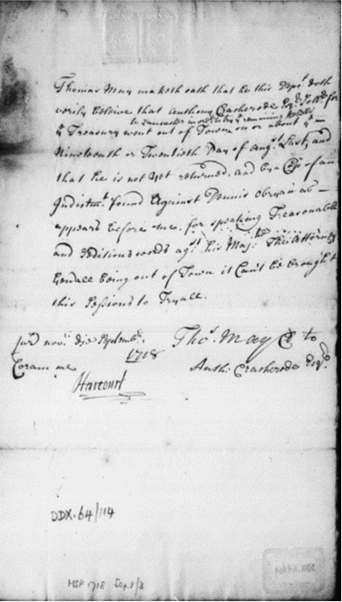
Old Bailey affidavit
of Sep 1718 stating the trial of Dennis O’Bryan could not proceed
After
spending time in prison Dennis O’Bryan was bailed in 1720. He continued to
support the Jacobite cause and was in contact with his ‘Viscount Clare’ cousins
in France. In 1725/26 Dennis O’Brien appears in several depositions identified
as being in the Lincoln's Inn Fields area of London and involved in recruiting
for the O’Brien Clare Regiment in France. Some of these depositions state that
Dennis O’Bryan sometimes used aliases such as Dennis Browne and Daniel O’Bryan.
In December
1726 Dennis O’Brien came to the attention of Under Secretary of State, Thomas
Townsend, who wrote to the Secretary to the Lords Justices, Charles Delafaye, requesting
an arrest warrant for Treason be drawn up for Dennis O’Bryan.
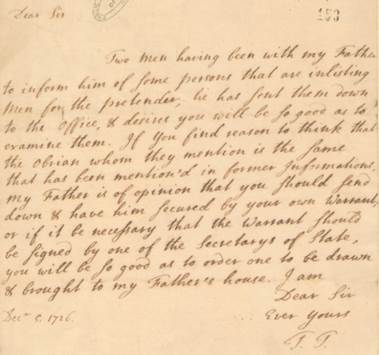
Letter dated Dec
1726 from Thomas Townsend to Charles Delafaye mentioning the O’Bryan arrest
Warrant
The next
mention of Dennis O’Bryan’s name I can find appears in the Middlesex Justices'
Working Documents dated 20th January 1727. These documents are organised files
of documents relating to the work of Justices of the Peace and kept by the
clerk of the peace. They include several different types of documents, relating
to the prosecution of criminals as well as other matters.

Dennis
O’Bryan mentioned in Middlesex Justices' Working Documents 20th January 1727
It is
unclear if this mention relates to the warrant (for High Treason) discussed
between Thomas Townsend and Charles Delafaye in December 1726, but whatever
happened seems to have had a profound effect on Dennis O’Bryan. This was
obviously serious and spurred Dennis into laying low; he went into hiding and permanently
changed his name to Daniel (his grandfather’s name) and dropped the “O” from
his name.
From this
time on we can see Dennis O’Bryan living in the semi-rural area of London at Spitalfields;
now married to Jane Key and using the name Daniel Bryan. He died in 1749 at the
London Infirmary (close to Spitalfields) and is buried in the Whitechapel church
yard under the name of Daniel O’Brian.
Daniel’s
eldest son Timothy Bryan married Catharine Edwards, their son Daniel was born
in 1769 and was baptised a Catholic at a house in White St Spitalfields that was used for Catholic services on the
12th April 1770, with Timothy Toole and Mary Smith as god parents.
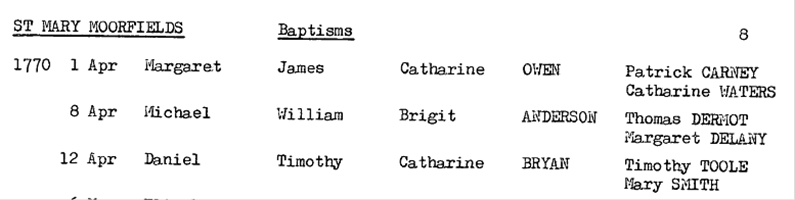
Transcript from the Catholic
Priest journals archived at St Mary Moorfields London of Daniel Bryan’s baptism
on 12th April 1770
Daniel
Bryan lived with his parents Timothy and Catharine in Phoenix St Spitalfields;
records show that the family had been at that address since at least 1753 and
the last written record we have of them being there is from 1783.

On the 17th
Nov 1786 Daniel’s father Timothy died and the following February Daniel was implicated
in a robbery which initiated his journey to New South Wales (NSW), Australia.
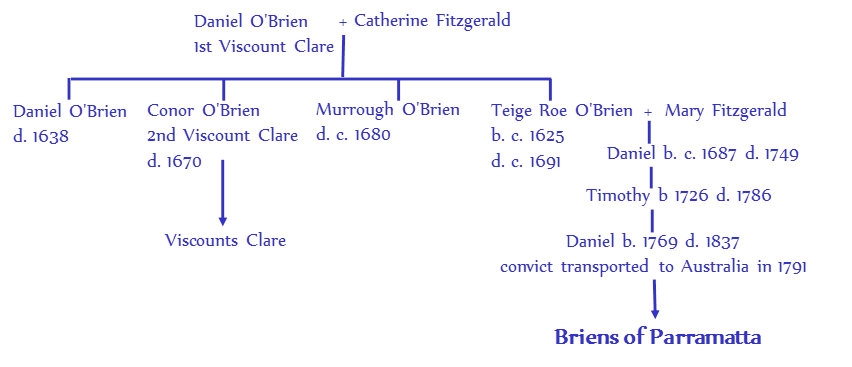
Chart showing our
line from Daniel O’Brien 1st Viscount Clare to Convict Daniel Brien
Daniel Brien’s trial and transportation to
NSW
Daniel Brien was indicted on the 7th February 1787 for stealing articles
of clothing worth £7.6.0/- the property of Susannah Walker, from a
boarding house at 22 Clapton Square Hackney, a London suburb. Daniel was seen
with a group of boys earlier in the day near Shoreditch church and they were
heading in the direction of Hackney. Those same boys were later seen with
Daniel when he was apprehended by some brick workers whilst heading back in the
direction of Spitalfields.
In his
defense Daniel (his name was spelt ‘Brian’ in the trial documents) stated that
he was going past the brick field and went to the assistance of a man carrying
some washing and who was being chased by two men. Daniel said he was
apprehended by mistake but the judge did not believe him and Daniel was found
guilty and sentenced to death.
On 19th September 1789 Daniel Brien accepted
the King’s pardon on condition of transportation to Australia for 7 years.
Daniel then spent the next two and a half years as a prisoner in various gaols
including fifteen months confined on the prison hulk “Dunkirk” moored in
Plymouth harbour waiting for a ship to become available to take him to
Australia.
Convict
transportation to Australia
Convict transportation to Australia (then
known as New South Wales) began largely as a result of the industrial
revolution in Britain. The two events have a causal relationship; as Britain
moved from a primarily rural society to become the world's first urbanised,
industrialised nation in the 18th and 19th centuries, the justice system
underwent its own transformation resulting in overcrowded prisons; one solution
adopted was to transport convicts to other parts of the world including
America. With the outbreak of the War of Independence in 1775 and the American
colonists ceasing to accept convicts; this led to overcrowding in English
gaols.
An alternate solution was sought and a
proposal made before a committee of the House of Commons by Botanist Sir Joseph
Banks in 1779, who stated that in his opinion “the place most eligible for the
reception of convicts was Botany Bay”. Banks had been aboard the ship ‘Endeavour’
with lieutenant James Cook on his first great voyage during which the east
coast of Australia was mapped for the first time. On that voyage the Endeavour
anchored in Botany Bay (just south of Sydney) on the 29th April 1770. Based on
Banks testament Botany Bay was selected as the site for a new settlement, and in
October 1786 Captain Arthur Phillip was appointed the first Governor of New
South Wales.
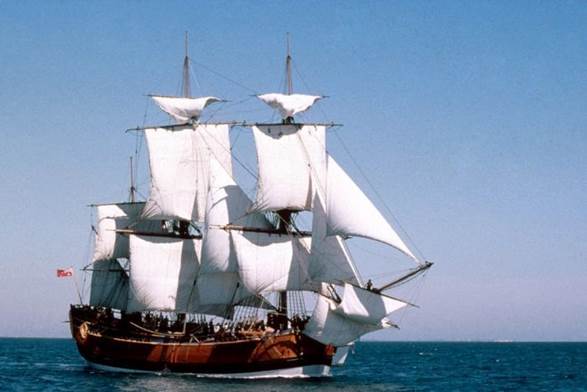
Endeavour replica under sail
The First
Fleet
Upon
arriving at Botany Bay on the 21st January 1788 Phillip deemed the site
unsuitable due to the lack of sufficient water, poor anchorage and sandy soil so,
he embarked with a longboat and two cutters to explore another harbour a few
miles to the north labeled on Cook’s map as ‘Port Jackson’.
Phillip
spent 3 days of reconnaissance in Port Jackson where he noted a bay with a
stream of fresh water which he named Sydney Cove; after the British Home
Secretary, the 1st Baron Sydney. Phillip described Port Jackson in his journal as
follows “...we had the satisfaction of finding the finest harbour in the world,
in which a thousand sail of the line may ride in the most perfect security...”.
Phillip then returned to Botany Bay on the afternoon of the 24th January and
readied the fleet carrying around 1400 convicts, soldiers and free people to sail
the approx. 8 miles along the coast to Port Jackson where they anchored in
Sydney Cove two days later.
On the 26th
January 1788, the British Grand Union flag was raised, and possession of the
land was taken formally in the name of King George III. This event is marked today
with a public holiday known as Australia Day.
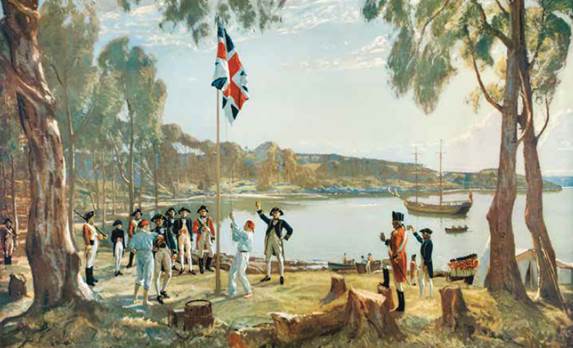
Sydney Cove
26th January 1788 (State Library of New South Wales)
On the 2nd
November 1788, Governor Arthur Phillip took a detachment of marines along with
a surveyor and, in boats, made his way upriver heading west from Port Jackson to
a location about 15 miles from Sydney Cove that he called The Crescent, a
defensible hill curved round a river bend, now in Parramatta Park. As a
settlement developed, Governor Phillip gave it the name "Rose Hill"
after British politician George Rose. On the 4th June 1791 Phillip changed the
name of the township to “Parramatta” approximating the term used by the local
Aboriginal people.
The first fleet was followed by two more
fleets.
The Second
Fleet
The second fleet (also known as the “grim convict
armada”) was a convoy of six ships arriving at Sydney in June 1790 and is
notorious for the poor treatment given to the convicts by the ship’s masters. Of
the 928 male convicts transported, 26 per cent died on the voyage and about 370
(nearly 40 per cent) were dead within months of their arrival in Sydney. This
shocking mortality rate is a major and brutal part of Australia’s history that
shouldn’t be neglected.
Our ancestors James Beckett and Ann Calcut
arrived in Australia on this fleet, and the fact they survived is a testament
to their strength of character and endurance.
James was aboard the ship ‘Surprize’ which made
the journey from England in 158 days arriving in Sydney on the 26th June 1790, and
Ann was aboard the ‘Neptune’ whose journey lasted 160 days arriving on the 28th
June 1790.
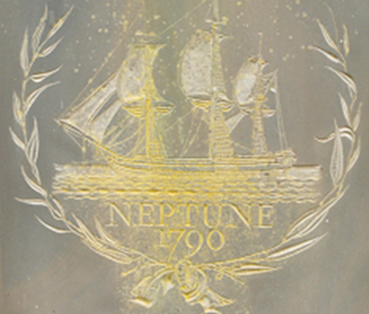
Commemorative plaque for the Neptune, the deadliest ship
of the second fleet
According to LJ Charleston, when the first
ships from the second fleet arrived those excitedly waiting on shore for the
new arrivals were greeted with a horrifying sight – dead and dying men,
shocking evidence of abuse, rampant disease and starvation.
“Few men could stand upright and those that
couldn’t crawl to shore were flung like sacks of flour overboard. Witnesses
reported seeing men with gaping wounds so deep from wearing irons for the
duration of the voyage, you could see their bones. Many of those struggling to
reach the shore were close to death.
Dysentery was rampant. Onlookers were
shocked to see men with bloated stomachs, bent over with painful cramps, others
with legs that were swollen and purple, others barely clinging to life with
blacken gums and loose teeth, grimacing in agony with scurvy.
Stories quickly spread about the cruel use
of irons, convicts concealing deaths of their mates so they could use their
rations and starving men forced to eat oatmeal poultices from dead bodies, (a
poultice was used to help cure infection).
Those that survived the brutal voyage were
so weak and ravaged by disease – adding extra pressure to a colony already
suffering the effects of dangerously low supplies – up to ten people died per
day in the week after their arrival.
Added to the mix was a group of selfish
contractors’ intent on cutting corners, a captain so paranoid about security he
refused to let convicts up on deck for fresh air and another captain whose
previous job had been overseeing slave ships.”
Governor Arthur Phillip was shocked and
appalled and immediately wrote back to England. Some of the ship’s Masters were
put on trial and in July 1792 the Attorney General and Solicitor General
reported to the King, recommending an inquiry which led to substantial changes
to the Convict transport system.
The Third
Fleet
Following the debacle of the second fleet, a
third fleet of eleven ships followed with more than 2,000 convicts including our
ancestor Daniel Brien who arrived in Sydney aboard the ship ‘Salamander’ on the
21st August 1791.
Daniel Brien’s story is curious at this
point as 155 male convicts disembarked the Salamander all of which, apart from
Daniel, were subsequently shipped off to the newly established convict penal
settlement on Norfolk Island. Why Daniel was singled out to remain in Sydney
remains a mystery.
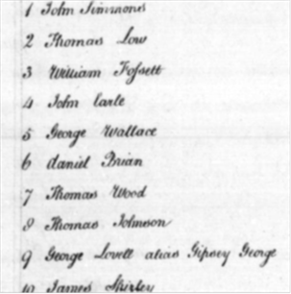
|
Daniel’s
name appears as prisoner No. 6 in the account of names “delivered for
transportation” beyond the seas. Dec 1789. |
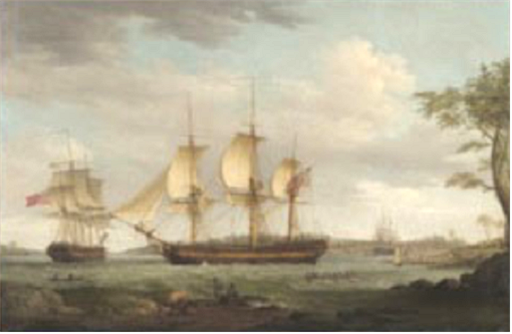
A ship similar to the Salamander |
The new settlement of Sydney initially
struggled to grow enough food to support the population however, by the time Governor
Arthur Phillip left the colony and returned to Britain on the 11th December
1792, the colony was taking shape, with official land-grants, systematic
farming, and a water supply in place.
After the third fleet, convicts were
transported to Australia on individual ships. In all, between 1788 and 1868
more than 162,000 convicts were transported to Australia. Today about 20% of
Australians can trace their ancestry to at least one convict.
Convict
life in Australia
As a rule, convicts were initially assigned
to an overseer but after a period they often obtained a ‘ticket of leave’ which
allowed them to work for their own benefit and to purchase (or be granted)
property on the conditions that they resided within a prescribed area, attended
a muster every few months and attended church weekly. The tickets had to be
renewed annually and permitted convicts to marry or bring their families over
from England or wherever they lived.
Once a convict had served their sentence it
was difficult for them to return to their country of origin due to the cost and
availability of passage, some did make the journey back, but the vast majority
remained in Australia.
Convict discipline however was invariably
harsh and often quite arbitrary. For those convicts who committed further
offences in the colony there was a variety of brutal punishments awaiting them.
One of the main forms of punishment was a thrashing with the cat o’ nine tails,
a multi-tailed whip that often also contained lead weights. 50 lashes were a
standard punishment, which was enough to strip the skin from someone’s back,
but this could be increased to more than 100 lashes. In 1797 two convicts
received 800 lashes each spread over two days.
Just as dreadful as the cat o' nine tails
was a long stint on a chain gang, where convicts were compelled to build roads and
other infrastructure for the colony. The work was backbreaking, and was made
difficult and painful as convicts were shackled together around their ankles
with irons or chains weighing 4.5kg or more. Worse than the cat or chain gangs
was transportation to harsher and more remote penal settlements in Norfolk
Island, Port Macquarie and Moreton Bay.
From the late 1820s many convicts were used
as unpaid labor on private pastoral leases that sprang up in response to the
expanding wool industry. This use of forced convict labor in the wool industry
was enthusiastically recommended by English judge John Bigge in his 1823 report
into Australian agriculture and supported by successive governors.
Capitol punishment was rife even in Sydney.
In one court session held in August 1821 twenty-three convicts were sentenced
to death; rough justice ensued at the time with documented cases of innocent
people being executed.
Whether by luck, application or skill, our
convict ancestors appear to have avoided the worst aspects of this brutal and
unforgiving environment.
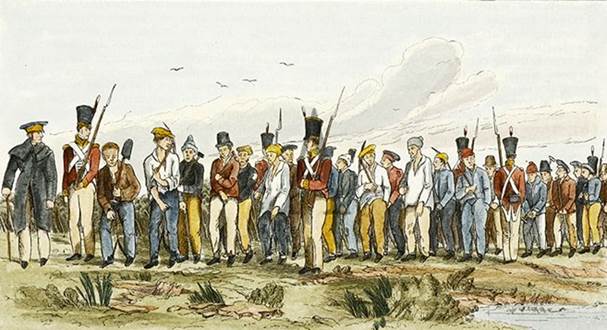
Convict Chain Gang (Great Northern Road Project)
Convict influence on Australian identity and
culture
Australia’s
Convict past left some indelible marks on our identity and culture, a number of
examples are described below.
Australian
Accent
An obvious
example is the Australian accent (known as the General Australian Accent) which
my research indicates evolved in the Hawkesbury River region NW of Sydney prior
to 1810.
The
Hawkesbury was settled from 1794 and many of the early families that settled
there brought children with them that had been born in either Sydney or
Parramatta. This relocation pattern was structurally tied to the convict
system. The adults who arrived in the Hawkesbury were by and large not
agriculturalists but urban laborer’s, artisans, servants, and tradespeople
thrust into a frontier with minimal institutional support. Their lives were marked
by economic precarity, environmental risk, and the constant threat of crop
failure or flood. Under such conditions, families clung together for survival.
Kinship networks deepened, intermarriage intensified, and households became
interdependent in ways rarely seen in free-settler societies. The result was a
social ecology characterised by dense kin clustering, shared labour, and
cross-household cooperation—a demographic configuration uniquely generated by
the convict experience.
The early convict
settlers originated from locations across Britain and Ireland; bringing
speakers of different accents together for the first time. The vastly different
accents spoken by adults in the Hawkesbury rural frontier society meant that children
operated in an ecology where adult linguistic input was inconsistent,
inaccessible, and functionally irrelevant. Additionally, children were
delegated adult roles including farm work and child rearing which they
conducted mainly in isolation from adult supervision—conditions that sharply
reduce adult-to-child linguistic transmission. As a result, the Hawkesbury
children were effectively severed from parental dialect influence. Their
linguistic environment was dominated not by British or Irish varieties, but by
the immediate demands of child-minding, coordination, and task-driven
cooperation. Under these conditions the children quickly created their own way
of speaking as this was required for them to communicate clearly, efficiently,
and consistently in order to manage younger children and maintain order within
forced-team structures.
The speech
developed by the Hawkesbury children was functionally independent of British
and Irish dialects spoken by the convict and settler adults. It did not
represent a simplified continuation of parental varieties, but a new,
child-constructed system built from the fragments of inconsistent adult input.
Hence, while Australian English is genealogically English, its structural
foundations were not transmitted from adults but reconstructed by native-born
children operating within a frontier ecology that constrained and directed the
system toward a unique outcome leaving the peer groups to create their own
linguistic standards. This occurred within a surprisingly short period of time
and once the children had stabilised their speech, this variety of speaking
became the norm across the Hawkesbury and quickly spread to nearby communities
of Seven Hills and Parramatta.
The
Hawkesbury, Seven Hills and Parramatta settlements formed an ‘accent basin’
from which the accent spread into rural New South Wales carried by families who
migrated in response to the wool boom of the 1830s and the ‘Champion drought of
the century’ —which set in from the mid-1830s and only broke in 1844—that drove
many livestock farmers from the Sydney settlements to search for green pastures
in the wider regions of New South Wales. Through these migrations the
Australian accent was carried nationally.
It can be
argued that the emergence of the early Australian accent was inseparable from
the emergence of an early Australian culture. The accent formed under the
structural pressures of the convict system, stabilised within the first locally
born generation, and spread inland through the demographic pathways created by
pastoral expansion. Because this process occurred before competing dialect
centres or large-scale immigration could reshape the linguistic landscape, the
cultural and linguistic norms of the founding community were propagated with
remarkable consistency across the continent.
Click here
to Download the full report into the origin of the Australian Accent
Egalitarian society
Another instance
of Convict influence on Australian identity is what we call our egalitarian
society.
The origin
for this can be traced back to convicts transported to Australia who resented
the inequality of their treatment. They and their descendants were strongly in
support of removing any aristocratic barriers to working-class political
participation.
Some of
these convicts were Irish political activists; one of which was William Smith
O’Brien - William and our convict Daniel Brien were 4th cousins.
William
Smith O’Brien was arrested in August 1848 on a charge of high treason and
sedition and transported to Australia aboard the ship ‘Swift’ to Hobart Town
Tasmania; arriving on the 27th October 1849. William was incarcerated for a
period in solitary confinement on Maria Island off the Tasmanian coast. While
in exile on Maria Island (and afterwards at New Norfolk, Tasmania) William
Smith O'Brien authored a book titled “Principles of Government” in 2 vols.
Published in 1855; in it O’Brien drafted the ideal
democratic constitution based on the ‘Chartist demands’.
These
sentiments prevailed when Australia was granted self-rule in 1856 and
established State governments based on the ‘Chartists demands’ that included the
elimination of property requirements to vote, use of the secret ballot, the
right of all males to stand for election and salaries for Members of
Parliament. These elements were radical for the time and, in many ways unique,
and changed one of the least-free jurisdictions on the planet to one that was
quite free and quite democratic for the time.
Australia
is often called a ‘Chartist’s democracy’ because these initiatives were
realised in the very first Victoria and New South Wales parliaments - well in
advance of the UK which had to wait until 1872 for the secret ballot and 1914
for universal manhood suffrage.
As such,
Australia’s political system was substantially home-grown, with many facets
based on Labour movements and not entirely derived from the UK government. As
historian Dr Tony Moore points out "We (Australia) achieved democratic
constitutions in advance of the UK in the 19th century, and we don't even
celebrate or understand that.”
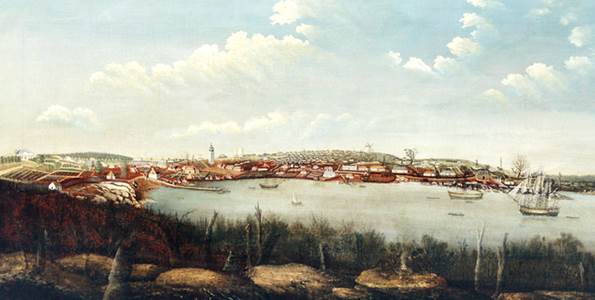
Sydney Cove about 1800 (NSW Art Gallery)
Daniel
Brien in Australia
The next we
know for certain about Daniel Brien is that in 1805 he appears in a convict
muster living at Parramatta; Daniel gives his occupation as “Laborer”. On the 23rd February 1807 he purchased thirty
acres of land on Vardy’s Road just north of Parramatta, and over the years
expanded his land holdings through further purchases and land grants in the
area known as ‘Seven Hills’.
Our
ancestor Daniel alternated the spelling of his name between Bryan, Brian and
Brien, but settled on the latter in the early 1800s. Daniel Brien married Ann Parker,
a convict from Bow in Devon England, at St John’s Anglican church at Parramatta
on the 29th January 1821. Around this time Ann changed her name to Mary Ann and
together with Daniel they had 11 children.
Catherine
Jane
Timothy
Mary Ann
Daniel
Elizabeth
Clara
John Robert
Sarah
James
Eleanor
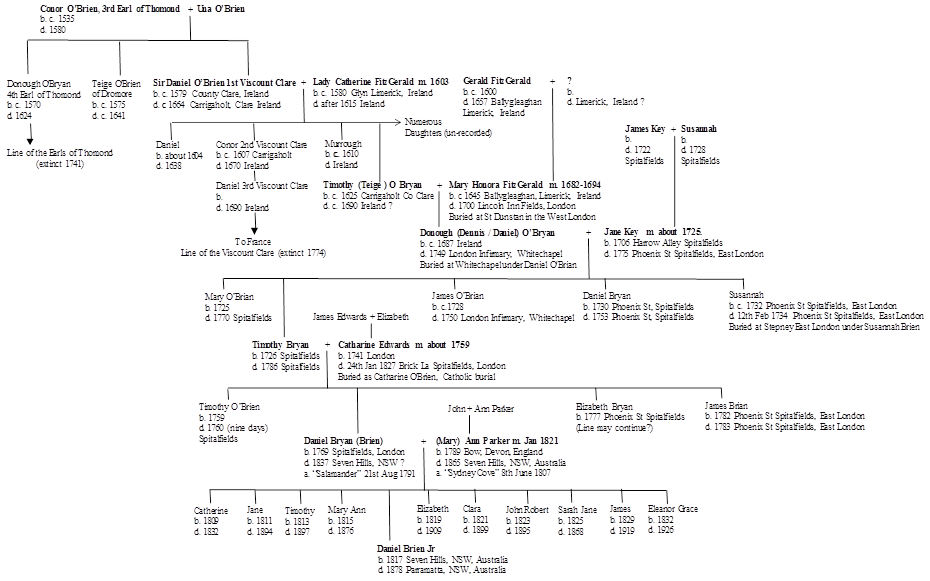
Chart showing line
from Conor O’Brien the 3rd Earl of Thomond to the children of Daniel Brien and Mary
Ann Parker.
Daniel and Mary
Ann’s 2nd son Daniel Brien Jr (Progenitor of our family line) is highlighted.
By 1816 Daniel Brien along with other nearby
land holders established a private school at Seven Hills for the education of
their children. Surviving documents show that 17 students were attending in
1823 with parents paying between half and one shilling per week.
The 1828 census shows Daniel aged 59 and
Mary Ann 39; both stating their religion as Catholic. The census also tells us
that Daniel and Mary Ann were living at Seven Hills with 300 acres in total,
with 50 acres cleared and cultivated, 5 horses and 97 cattle. Along with their
children they also had three allocated convict servants.
Daniel and Mary Ann’s property at Seven
Hills was known as ‘Exeter Farm’ named after the prison in which Mary Ann
Parker had been held. One of the houses on the Exeter Farm property was
restored in 2010 by the Historic Houses Trust and in June 2012 the Exeter Farm
restoration won the Heritage Greenway award.
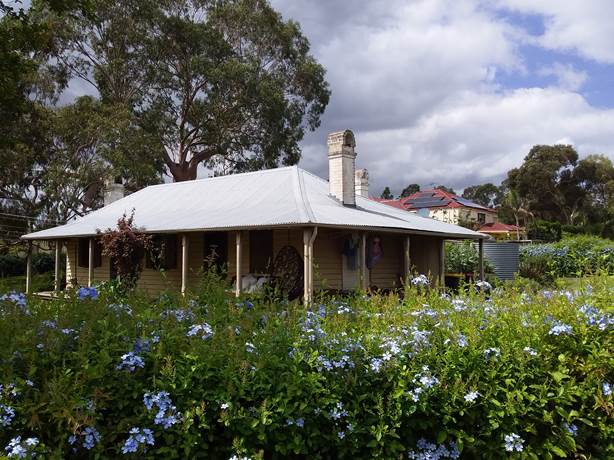
Exeter Farm homestead
that won the Heritage Greenway award (photo taken in 2020)
All of
Daniel and Mary Ann’s children married into other substantial land holding
families, and appear to have done well during their lifetimes as squatters,
farmers or business owners. Some of their children remained in and around
Parramatta, while others spread out across Eastern New South Wales and into
Victoria.
Convict
Daniel Brien died in 1837 and although it is assumed, he was buried at St
John’s church yard Parramatta, no sign of his grave has been found. Mary Ann
Parker re-married after Daniel’s death and died in 1865 under controversial
circumstances and is buried at St John’s Parramatta.
This
narrative continues by following the line of Daniel and Mary Ann’s 2nd son;
Daniel Brien Jr (1817-1878) who was the Progenitor of our line of Briens that
resided in Parramatta for generations. These Briens were a well-known family in
the area whose main occupations were as publicans and later butchers.
After his
father’s death in 1837 Daniel Brien Jr inherited 50 acres of the Exeter Farm property
bordering on Old Windsor Road. He later ran several hotels in Parramatta and had
the distinction of providing food and beverage for the celebrations associated
with Australia’s first train service from Sydney to Parramatta in 1855. In 1875
Daniel stood for election to the Parramatta Council.
In 1838 he
married Mary Ann Best; granddaughter of George Best who had substantial
property interests around Parramatta as well as to the south and west of Sydney
including the towns of Gunning and Wagga Wagga. George Best was one of the
wealthiest people to die in NSW before 1840 and there are substantial monuments
standing in St John’s cemetery Parramatta dedicated to members of the Brien and
the Best families.
The Wool
industry in Australia 1820 - 1900
Prior to
1820 the main exports from Australia were whaling and sealing - these ocean-based
industries provided little in the way of foreign income. In 1797 a small flock
of highly prized Merino sheep were brought to Sydney and purchased by
Australian wool pioneer John Macarthur. Macarthur, along with other breeders
including our ancestor George Best, are recognised as ‘pioneers of Australia’s
wool industry’.
George Best
was one of a select group of ex-convicts who rose to be members of Australia’s
pastoral ruling class known as the ‘Squattocracy’.
George Best
and his descendants rode the sheep’s back through the period known as
Australia’s ‘pastoral age’. This period came about through Australia’s intimate
connection to Britain which meant that the effects and benefits of the
Industrial Revolution were felt here earlier than in many other countries. This
was borne out when Britain mechanised its woolen mills and the burgeoning wool
industry that resulted created an insatiable demand for Australian wool. George
Best was one of those who saw the potential for a wool export industry; he
contributed to the 1821 Bigge Royal Commission ‘The State of Agriculture and
Trade in the Colony of New South Wales’ and in 1823 he travelled to England
to further contribute. On his return the following year Best expanded his
operations, with virtually free access to vast tracts of land to farm the pastoralists’
expansion into the interior of eastern Australia was extremely rapid.
Despite the
transport costs involved, wool exports multiplied two hundred times between
1820 and 1850 as wool growing emerged from insignificance to become a powerful
source of economic growth. By 1849 Australia had become the dominant supplier
of wool to England, selling a staggering 16,300 tons of wool that year, more
than all of Europe’s production combined. The growth in export income from wool
quickly broke the limitations inherent in Australia’s initial convict period
reliance on the domestic market.
Wool set
Australia on its first genuinely capitalist phase of economic development
spurred on by the introduction of British money as Australian currency in the
1820s facilitating international trade, the banking and finance systems that
followed and self-government in the 1850s, all providing key stepping stones
towards establishing Australia’s modern economy.
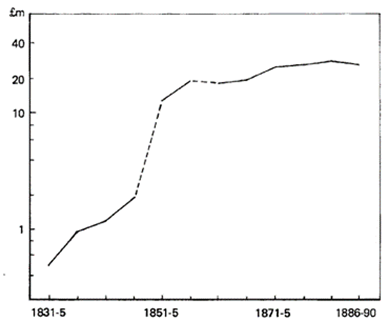
Graph showing Australia’s export revenue growth between
1830 and 1890
Our Briens
in Parramatta
Mary Ann
Best’s maternal grandparents were James Beckett and Ann Calcut; both of whom
arrived at Sydney in 1790 on the second fleet.
James
Beckett was a skilled brick maker from Shrewsbury England and has the
distinction of establishing the first brick-making operation in Parramatta.
James Beckett learnt his craft in northern England, and so, produced bricks following
the Birmingham standard; these bricks can still be identified today in
Parramatta. James Beckett seems likely to have also been involved in the
construction / maintenance of Beckett’s Bridge at Parramatta, which spans
Beckett’s Creek.
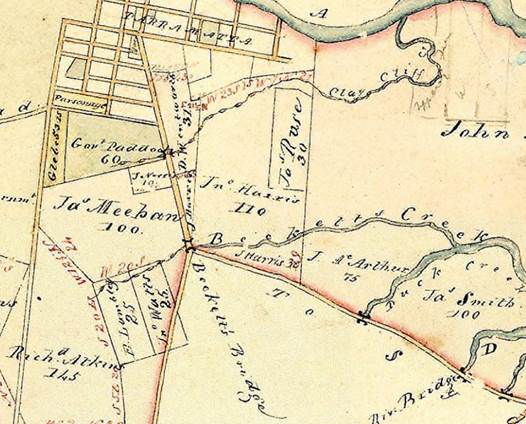
Early map of
Parramatta showing Becketts Bridge and Becketts Creek
These
landmarks appear on Parish Maps produced in the colony which date from the
1790s. It is obvious when you examine these and other documents from the period
that key skills, knowledge, methodologies, technology and the associated
culture of invention had arrived in Australia with the early fleets. Surveying,
cartography, town planning, road and building construction, maritime
operations, farming and food production etc. are evident. The first fleets to
Australia arrived in the middle of the Industrial Revolution so as expected milestones
of that period and western civilization in general also appear including; government,
military, policing, hospitals, farming, commerce, religion and so forth. The
first newspaper in Australia (The Sydney Gazette) was in production by 1803 and
our ancestors are prominent throughout its pages giving valuable insights into
our history.
James
Beckett and Ann Calcut also held a 30-acre property just north of Parramatta at
Toongabbie. After her husband’s death around 1808 Ann Calcut, a country-woman
like so many of her contemporaries, managed the farm with the help of her two
sons. Ann died somewhere between 1821 and 1828, her grave has not been located.
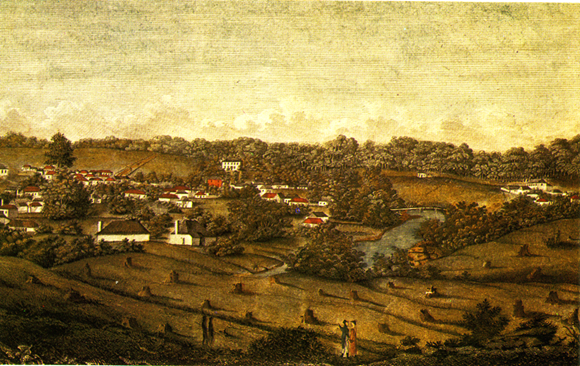
Parramatta in 1812
Daniel
Brien and Mary Ann Best’s son Daniel followed in his father’s footsteps and was
also a publican in Parramatta; he married Bridget Ryan in 1865. Bridget’s
father Michael Ryan was a Police Officer, as was his brother John Ryan who held
the position of Chief Constable of Parramatta and later that of Assistant Chief
Constable for the entire Sydney region. Bridget’s paternal grandfather Michael
Ryan was a convict revolutionary from County Clare Ireland. Her maternal grandfather
James Cook was also a convict from County Clare, he was industrious enough to
purchase sizeable land holdings just south of Parramatta in what was then known
as Irishtown. Substantial monuments to the Cook family can be seen today at St
Felix cemetery in what is now known as Bankstown. Bridget outlived her husband Daniel
by 30 years and she was still living at Parramatta when she died in 1917.
Daniel
Brien and Bridget Ryan’s son George Brien was a
butcher in Parramatta; he married Mary Jane Farrell in 1891. Mary’s grandparent
Mary Anne Chilvers and her father John Chilvers were free settlers from New
Buckenham, Norfolk, England. They arrived at Sydney in 1849 and crossed the
Blue Mountains to the west and settled at Bathurst NSW. They arrived just before
the gold-rush of 1851 which transformed the area. The Chilvers were a well-known
family of footwear makers and ran businesses in the townships of Bathurst and Millthorpe
NSW. The family eventually moved back across the mountains and settled near Parramatta
at Vineyard where George Brien and Mary Jane Farrell were married in 1891.
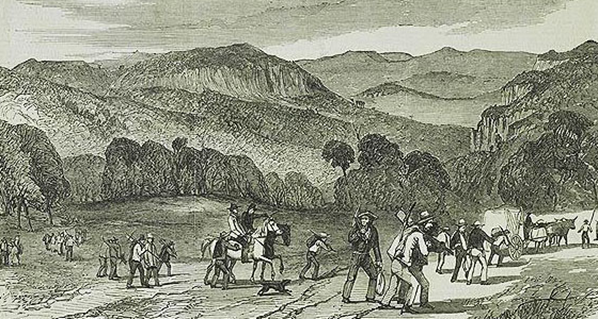
Crossing the Blue Mountains to the Gold Fields (1851)
George
Brien and Mary Jane Farrell’s son George Daniel Brien was also a butcher and
established a wholesale meat business in Parramatta; he married Sarah Osborn
Hammell in 1912. Sarah was present in 1911 when her relative, pioneering
Australian aviator William Hart, landed his plane in Parramatta Park following
the first cross-country flight recorded by an Australian in aviation history. William
Hart went on to win Australia’s first air race against American, Eugene
'Wizard' Stone, and Hart established a flying school at Richmond NSW, which
became the site of today’s Australian Air Force Base. William Hart influenced a
generation of young pilots including Bert Hinkler whom he gave his first
powered flight, and Charles Kingsford Smith.
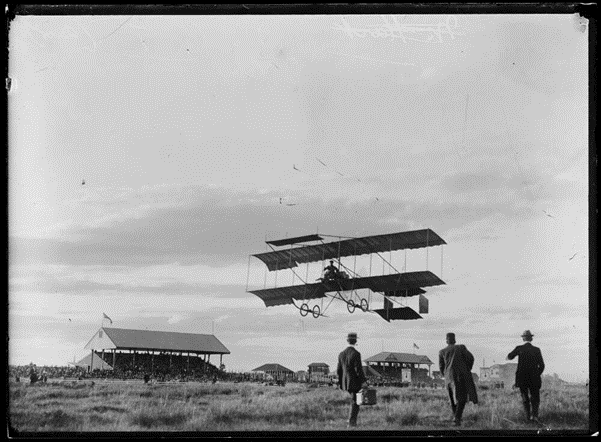
William Hart taking off in his Bristol Boxkite plane (National
Library of Australia)
Sarah’s
paternal great grandfather was convict John Hangan; one of the initial settlers
of Hobart Tasmania. Sarah’s maternal grandfather Pierce O’Keeffe was a
Barrister; educated in England and France he sat on the NSW and Victorian Bar. Pierce’s
father Patrick O’Keefe was a businessman in the Hunter River region of NSW based
in Morpeth; he sat for many years on the board of the Hunter River New Steamship
Navigation Company. Over its lifetime the company ran around 40 ocean-going
steam ships, one of which - The Maitland - is illustrated in the painting
below.
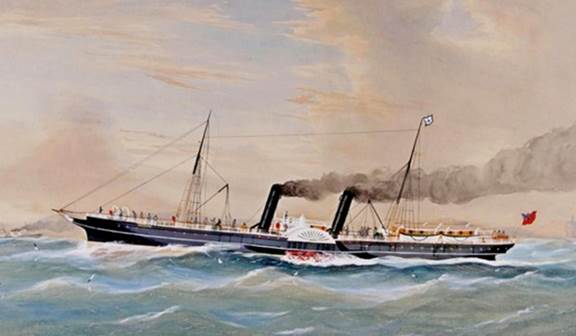
Hunter River Steamship “Maitland” (Flotilla Australia)
George
Daniel Brien and Sarah Osborn Hammell were my grandparents, they settled in
Harris Street Parramatta before moving to Enid Ave in 1939. This narrative ends
with the story of their eldest son George William Brien who married Maisie
Hickey in 1937. Like his father, George William Brien was also a butcher and together
with Maisie they had five children of which I am the youngest.
Maisie’s
parents were William Hickey and Florence Miller. William and Florence were
married at Lismore on the north coast of NSW in 1903. William Hickey was born
in 1874 at Aruluen; the location of a gold rush in southern NSW. William’s
parents James Hickey and Bridget Beston were from Scariff in County Clare
Ireland and immigrated to Australia in 1863.
Florence
Miller was born in 1884. Florence’s parents John Miller and Emma Howlett were
married at Wolverhampton England in 1882 but were living in London when
Florence was born. They arrived in Australia on the ship “Abyssinia” in 1887.
Maisie Hickey
was at the opening of the Sydney Harbour Bridge on Saturday the 19th March
1932. An estimated 250,000 people covered the vantage points of the harbour for
the opening ceremony.
George & Maisie Brien’s granddaughter Emma, with her
daughters Florence and Nina, in front of the Sydney Harbour Bridge
On the far shore is Sydney Cove – where convict Daniel
Brien stepped ashore in 1791
As we are
the descendants of convict Daniel Brien, the line of the Kings of Thomond, Earls
of Thomond and Viscount Clare live on today in us.
For a more
comprehensive version of our family narrative please see the ‘Kings to
Convicts’ document available for download from the home page.
Parramatta today
Our male
line from Brian Boru to the 20th century (George Brien* b. 1914 is my father)
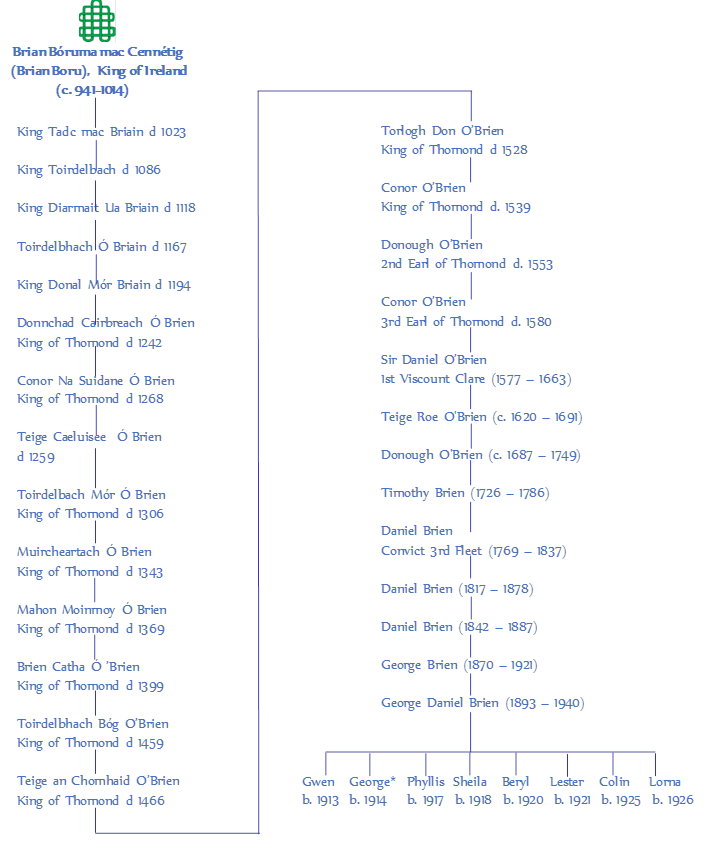
*
George Brien b. 1914 is my father.